

The most common mistake in budget PCP shopping is treating every rifle in a brand’s lineup as a version of the same thing. A buyer sees three models at three price points and assumes the most expensive one is “the best” and the cheapest one is “the beginner option.” That logic works for phone storage tiers. It does not work for air rifles, because the differences between models are not just increments of quality. They are differences in purpose.
Pinty’s current PCP range illustrates this better than most budget brands because the three central models—the Falcon, the Falcon X, and the Nighthawk—are not arranged in a straight line from entry-level to flagship. They overlap in price more than a linear hierarchy would suggest, and each one solves a different problem. Understanding those problems is more useful than comparing spec sheets line by line.
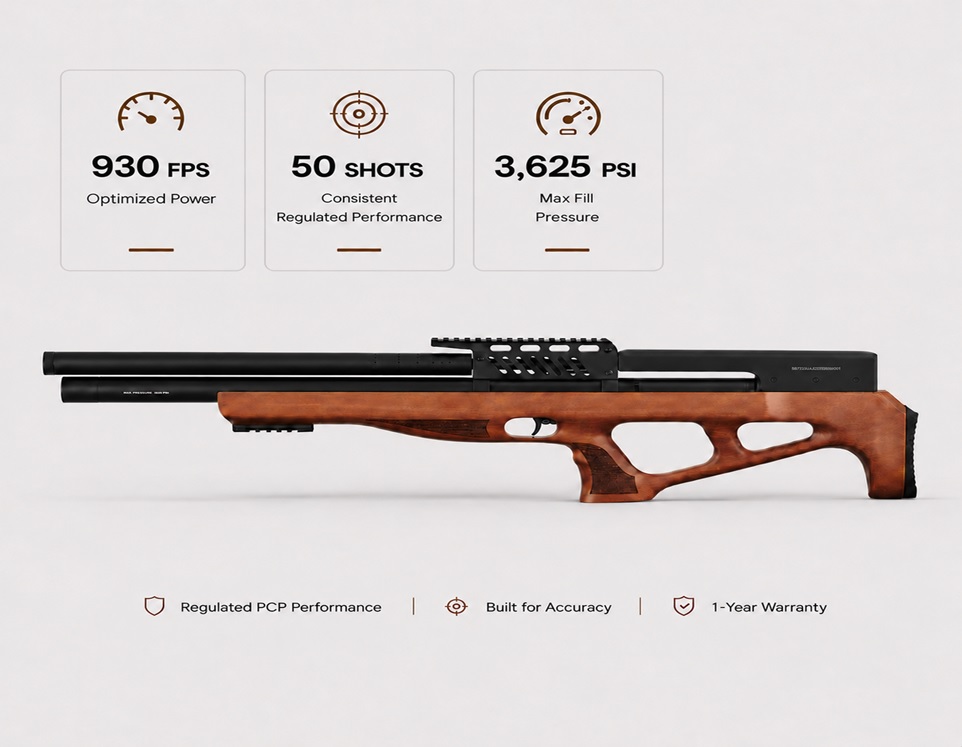
The Pinty Falcon is the traditionalist’s bullpup. It uses a real wood stock—walnut, not a polymer shell with a wood-look finish—and produces 930 FPS in .22 with 31 foot-pounds of muzzle energy from a 310cc cylinder. The regulated shot count is 50, the magazine holds nine rounds, and the trigger breaks at roughly 1.5 to 2.5 pounds. At $419.99, it sits in the middle of the range, but its identity is not “middle.” It is the model for a shooter who wants a bullpup that feels like a traditional rifle in the hand, with a stock material that ages rather than wears. Airgun Detectives reviewed it and called it “one of the most impressive bullpup PCP air rifles in its class,” with an average velocity of 880 FPS in testing and a 2-pound trigger pull. That is not a beginner gun being praised politely. That is a gun being evaluated on its own terms.
The Falcon X Compact Bullpup takes the same bullpup form factor and pushes it toward air efficiency and shot count. The cylinder grows to 630cc, the regulated shot count jumps to 160, and the total shots per fill reach 180. Velocity is 900 FPS with 33 foot-pounds, and the weight is 7.83 pounds—heavier than the Falcon, but carrying more than twice the air capacity. At $559.99, it is the most expensive of the three, but the premium buys a specific capability: the ability to shoot for an extended session without refilling. Air Shootist praised the 580cc carbon fiber bottle and the air efficiency, calling it a “nice little shooter for the price.” For a shooter who spends a full afternoon at the range or who does not want to carry a tank, that efficiency is not a luxury. It is the reason to choose this model over the cheaper Falcon.
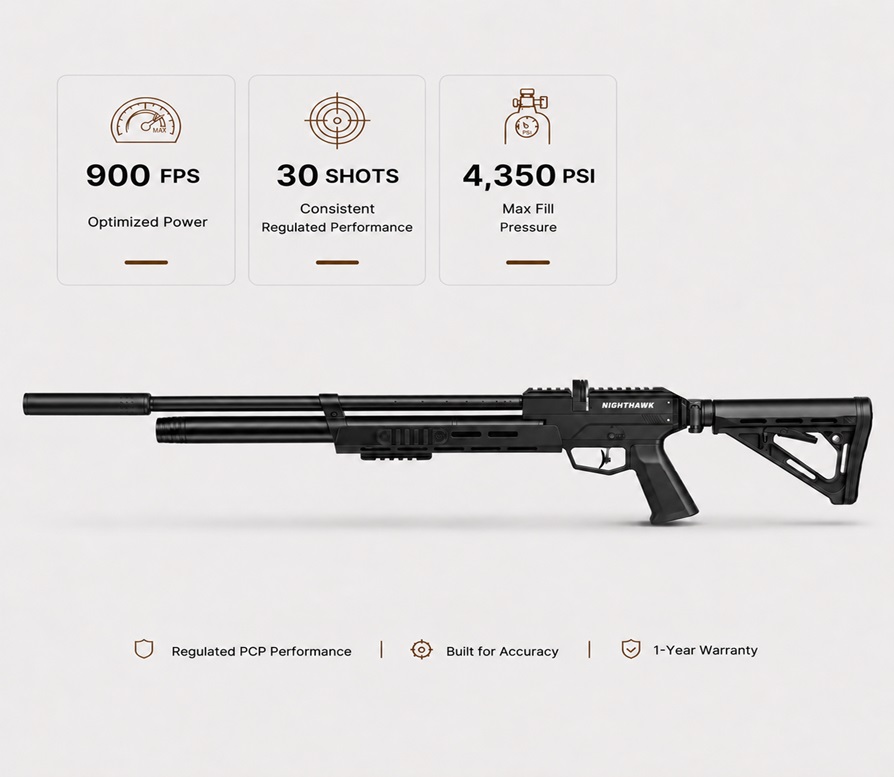
The Pinty Nighthawk is the outlier in the group, and that is its purpose. It is the only one of the three offered in both .22 and .25 caliber, and the .25 version produces 850 FPS with 40.7 foot-pounds of muzzle energy—more energy than either Falcon. The cylinder is smaller at 200cc, the regulated shot count is 30 in .22 and 25 in .25, and the fill pressure goes up to 300 BAR rather than 250. At $349.99, it is the least expensive of the three. The Nighthawk is not trying to out-bullpup the Falcon or out-efficiency the Falcon X. It is a hunting-focused platform in a more conventional stock configuration, with the caliber option that small-game hunters actually want. A .25 caliber PCP at this price point with this energy level is a different value proposition from either Falcon, not a lesser version of them.
The broader Pinty PCP air rifle lineup places these three alongside the Nightfall MKII and the Buster pistol, and the range as a whole makes the same point: the brand is not selling a ladder. It is selling a set of tools for different jobs. The Falcon is the wood-stocked bullpup for the shooter who values feel and tradition. The Falcon X is the high-capacity platform for the shooter who values time between fills. The Nighthawk is the multi-caliber hunter for the shooter who values energy and a conventional hold. None of them is “the best” in isolation. Each one is the right answer to a different question.